Unequal land distribution is not the only land issue in Paraguay. The FNC (the country's leading voice of the peasant farmer, primarily cotton farmers) is also upset at foreign soybean producers who take advantage of cheap Paraguayan labor and land. Foreigners have planted half of Paraguay's usable land as genetically modified soybeans and made the country the forth largest soybean exporter in the world (see here for more export numbers).
Additionally, there are rumors of widespread use of pesticides and fertilizer that poison the soil and harm near-by residents. FNC has organized a number of protests during which two protesters were shot dead when they failed to stop at a police check point. The landowners said cannot spray the soybean fields without angering the peseants and and began protesting themselves. Their group, Coordinadora Agricola de Paraguay, say the peasants are extorting the landowners so they will give up thier land.
Thursday, May 17, 2007
Paraguay's Land Problems
After Paraguay's defeat in the War of the Triple Alliance (1865-70) the country was forced to pay reparations to Argentina and Brazil. The state sold huge tracts of land in northern part of the country near the 3 boarder region. That trend continued when multinational companies from Brazil and the US starting buying the land and developing mechanized farm production. Now most of Paraguayan farmland is owned by a very few foreigners. This from an Intelligence Research report dated 21 December 2004:
 So in November 2004, after several failed promises by the Duarte government, a group know as the National Federation of Campensios (FNC) began invading and taking land from farms greater than 30,000 ha in central San Pedro and south-central Caazapa. That same month in two separate incidents FNC members raided a police station and also killed a police officer.
The land invasions were eventually put down and arrests were made on hunderds of campensios squatting on the siezed land. Also arrested was the FNC secretary-general, Odilon Espinola.
In December another FNC leader, Marcial Gomez, met with President Duarte.
...i don't know how this was resolved...
The Duarte government has since made appeals to the poor cotton farmers, offering $50 subsidies to farmers not able to sell at the minimum price. FNC rejected the offer. Duarte then upped his offer, pledging and to promote a debt refinancing program and to absorb the debts of-scale cotton producers made by purchasing agrochemicals.
Paraguay has several organizations pushing for land reforms: the National Coordinating Committee of Campesino Organizations led by Luis Aguayo; the National Campesino Federation led by Odilón Espínola and Marcial Gomez
At least half of Paraguay's land is owned by foreigners. The data on land tenure provided in the agricultural census of 1991 (see bottom page 11) shows that there were 307,000 landholdings in Paraguay. Some 62% of these farms had less than 10 hectares each and owned just 2.8% of total land. The largest 884 farms, 0.3% of the total, had more than 5,000 ha each and accounted for 56% of total land. The smallest farms or minifundios averaged 1.7 ha, or less than is necessary for one family's subsistence.Mechanized farming did little to help Paraguay's overwhelming poor population: the peasants couldn't afford to invest in such farming themselves and because the practice minimized labor they had no jobs for them either.
 So in November 2004, after several failed promises by the Duarte government, a group know as the National Federation of Campensios (FNC) began invading and taking land from farms greater than 30,000 ha in central San Pedro and south-central Caazapa. That same month in two separate incidents FNC members raided a police station and also killed a police officer.
The land invasions were eventually put down and arrests were made on hunderds of campensios squatting on the siezed land. Also arrested was the FNC secretary-general, Odilon Espinola.
In December another FNC leader, Marcial Gomez, met with President Duarte.
...i don't know how this was resolved...
The Duarte government has since made appeals to the poor cotton farmers, offering $50 subsidies to farmers not able to sell at the minimum price. FNC rejected the offer. Duarte then upped his offer, pledging and to promote a debt refinancing program and to absorb the debts of-scale cotton producers made by purchasing agrochemicals.
Paraguay has several organizations pushing for land reforms: the National Coordinating Committee of Campesino Organizations led by Luis Aguayo; the National Campesino Federation led by Odilón Espínola and Marcial Gomez


Tuesday, May 15, 2007
US Soybean Subsidies
Between 1995-2005 US soybean growers were given $13 billion in federal subsidies. Payments peaked in 2001 at over $4 billion and have come down in recent years to $500,000 while corn surges ahead at over $9 billion. Most of these subsidies went to large farms earning about $3 million over ten years. More than 80% of all soybean subsidies went to farms in the top 20%. (All this comes from the Environmental Working Groups Farm Subsidy Database)
Farm subsidies are the favorite whipping boy of urban anti-corruption groups who see them as handouts that take money away from other worthy programs and suppress market forces endangering free trade. In part they are right. When soybean subsidies peaked in 2001 global soy prices reached an all time low. Also interesting is that total revenue from soybean sales appears independent of subsidies. Note the 2004 jump when subsidies were low.

Either way, President Bush has supported cutting farm subsidies in the 2007 farm bill, especially direct payments to large farms. However, public opinion still leans in favor of subsidies because America's food supply is too important to risk to economic fluctuations and farmer need protection from cheap labor overseas. Here's a survey that shows farmers and their subsidies still enjoy a great amount of public support nation wide.
Farm subsidies are the favorite whipping boy of urban anti-corruption groups who see them as handouts that take money away from other worthy programs and suppress market forces endangering free trade. In part they are right. When soybean subsidies peaked in 2001 global soy prices reached an all time low. Also interesting is that total revenue from soybean sales appears independent of subsidies. Note the 2004 jump when subsidies were low.

Either way, President Bush has supported cutting farm subsidies in the 2007 farm bill, especially direct payments to large farms. However, public opinion still leans in favor of subsidies because America's food supply is too important to risk to economic fluctuations and farmer need protection from cheap labor overseas. Here's a survey that shows farmers and their subsidies still enjoy a great amount of public support nation wide.
Monday, May 14, 2007
Global Soybean Roundup
Had enough of soybeans yet?
Globally, oilseed production has increased 22% (80 million tons) in the last five years. (Soybeans account for the largest share of oilseeds, 86%). The increase in oilseed imports comes entirely from China whose imports have increased by 42% (8 million tons). The top five exporters of oilseed are:
United States 30.59 (million tons)
Brazil 25.77
Argentina 7.71
Canada 7.39
Paraguay 3.84
China 1.53
Ukraine 1.09
In the last three years two countries have show dramatic increases in exported oilseed: Canada (60% increase) and Paraguay (32%). USDA's Foreign Agriculture Service says Paraguay has the world's fastest growing oilseed production, projecting their 2007 crop to expand 65% over last year's (for chart, click here and choose table 11 under "field crops").
Diving into Paraguay's agriculture statistics (CSV database available here) we see Paraguay's soybean production is up 53% since 2003 and up 117% since 1996. By the same token exports have increased 37% in 3 years and 77% in 10 years. What's most startling is the amount of land being converted to fuel this boom: since 1996 more than 3 million acres have been turn to soybean production (the size of Connecticut) and just last year nearly a million acres were turned to soybeans (about 60 times the size of Manhattan)
The vast majority of Paraguay's crop are exported. In fact, after the soybean boom of 1976 more than half of Paraguay's soybeans were exported. In recent years Paraguay typically exports 60-70% of it's soybean crop.
Globally, oilseed production has increased 22% (80 million tons) in the last five years. (Soybeans account for the largest share of oilseeds, 86%). The increase in oilseed imports comes entirely from China whose imports have increased by 42% (8 million tons). The top five exporters of oilseed are:
United States 30.59 (million tons)
Brazil 25.77
Argentina 7.71
Canada 7.39
Paraguay 3.84
China 1.53
Ukraine 1.09
In the last three years two countries have show dramatic increases in exported oilseed: Canada (60% increase) and Paraguay (32%). USDA's Foreign Agriculture Service says Paraguay has the world's fastest growing oilseed production, projecting their 2007 crop to expand 65% over last year's (for chart, click here and choose table 11 under "field crops").
Diving into Paraguay's agriculture statistics (CSV database available here) we see Paraguay's soybean production is up 53% since 2003 and up 117% since 1996. By the same token exports have increased 37% in 3 years and 77% in 10 years. What's most startling is the amount of land being converted to fuel this boom: since 1996 more than 3 million acres have been turn to soybean production (the size of Connecticut) and just last year nearly a million acres were turned to soybeans (about 60 times the size of Manhattan)
The vast majority of Paraguay's crop are exported. In fact, after the soybean boom of 1976 more than half of Paraguay's soybeans were exported. In recent years Paraguay typically exports 60-70% of it's soybean crop.
Friday, May 11, 2007
US Soybean Roundup
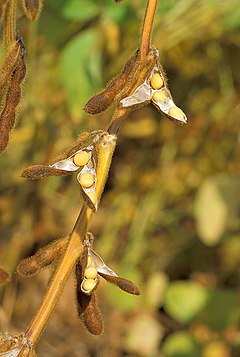 Let's talk soybeans.
Soybeans are a legume that grow about 8" high. They cover more the 75 million acres in the US and gross more than $18 billion a year making soy the second biggest planted field crop. (For a little perspective, New Mexico is 73 million acres and the porn industry sells $20 billion in adult movies).

Here's a link to basic soybean stats. And here's a map of where soybeans are grown (mostly along the Mississippi and Arkansas rivers).
The soybean industry is quick to call soy a miracle crop that accounts for 64% the world's protein consumption. They are, as they say, "the world's foremost provider of protein and oil." I wouldn't know how to qualify that other than saying that Tyson Chicken also call themselves "the world's premiere protien provider," and Damien in the movie Omen also called himself the leading provider of protein.
 Nevertheless, US soybean production has increased 33% in the last 10 years thanks to China doubling it's soybean imports to to be used for humming meat consumption. In fact, China is the only country buying more and more American soy exports, roughly $2.5 billion or 36% of all exports and 13% of US soybean production.
Another reason for the increase in soybean production is biofuels (more to come soon).
 All this being true, soybeans are loosing ground to corn and overall soybean prices are about the same as they were 30 years ago (though there has been a 23% jump in soybean oil prices--again, more to come soon). For 2007 crops corn is expected to out-earn soybeans; estimates say soybeans will earn nearly $100/acre than corn thanks mostly to increased demand for corn-based ethanol.
Subscribe to:
Posts (Atom)